
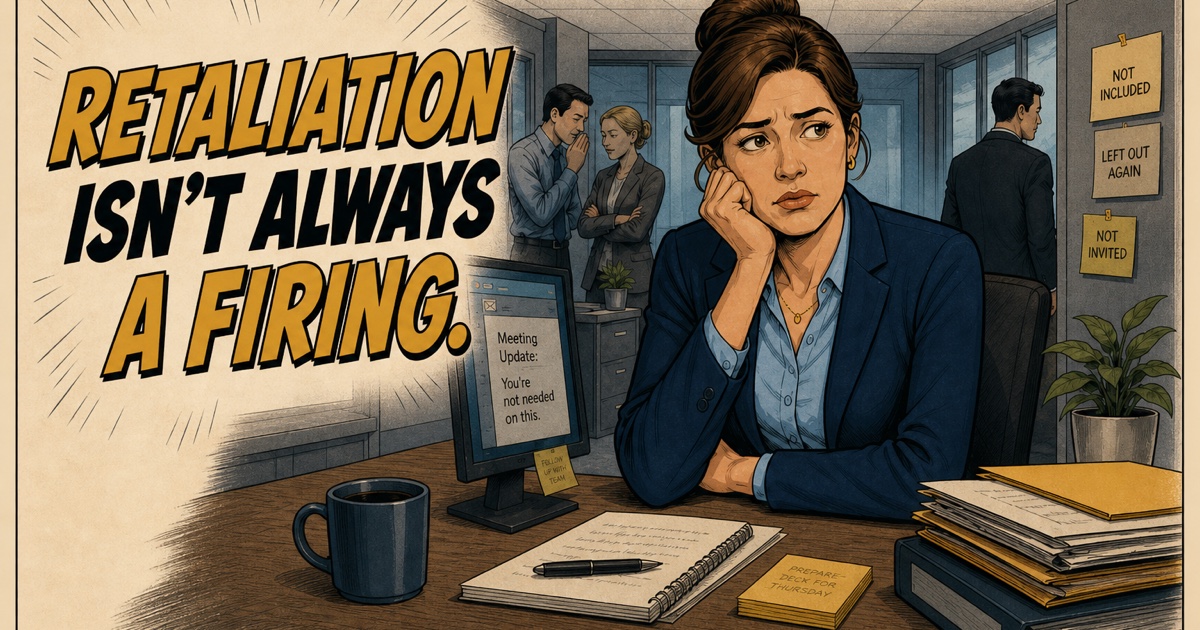

Retaliation rarely announces itself with a termination letter on day one.
More often it looks like this: you speak up about something that felt wrong. Then the invitations stop. The good projects move to someone else. Access disappears. Suddenly there is a paper trail that makes you look like the problem.
That pattern is the story in our short comic reel above — an illustrative dramatization, not a real case. If any of it feels familiar, keep reading.
What the comic is showing
The reel walks a common sequence:
- Exclusion — left off meetings, “you’re not needed on this,” sticky-note isolation.
- You speak up — a good-faith complaint to HR or a manager.
- Assignments change — access removed, priorities rewritten, names crossed off the project board.
- It goes in writing — a sudden Performance Improvement Plan that reframes the story as your performance.
- You prepare — timeline, witnesses, evidence — before the narrative hardens against you.
An adverse employment action is still a major part of most retaliation cases — a firing is simply the clearest one. What the comic highlights is that the pattern of reprisal can start earlier. Courts and agencies often look at the total picture: timing after protected activity, shifting explanations, and whether the employer’s paper trail starts only after you complained.
Virginia law that can protect workers who speak up
Virginia maintains several statutes that forbid retaliation (or discrimination for protected activity) in specific contexts. Our Virginia Employment Code Library keeps unannotated Code text available to browse. Useful starting points:
- Va. Code § 2.2-3905 — core Virginia Human Rights Act employment provisions (unlawful discriminatory practices, including retaliation in the VHRA framework).
- Va. Code § 2.2-3908 — VHRA civil actions and enforcement pathways.
- Va. Code § 40.1-27.3 — Virginia’s general whistleblower statute protecting good-faith reports of suspected law violations.
- Va. Code § 2.2-3011 — VFATA whistleblower protections against retaliation for reporting fraud against the Commonwealth.
- Va. Code § 65.2-308 — retaliatory discharge for filing a workers’ compensation claim.
- Va. Code § 40.1-51.2:1 — discrimination against employees for exercising VOSH safety and health rights.
Federal law (for example Title VII retaliation) may also apply depending on your facts, employer size, and deadlines. Virginia’s longer VHRA filing window after July 1, 2026 does not rewrite the usual federal 300-day EEOC clock — calendar both if federal claims may matter.
Which statute fits — if any — is fact-specific. Reading a Code section is not a diagnosis of your claim.
What to document while it is happening
If you are living this pattern, write it down while dates are fresh:
- When you complained (to whom, how — email, meeting, hotline).
- What changed afterward (meetings, access, duties, pay, schedule, reviews).
- Who still got the opportunities you lost.
- Copies of PIPs, write-ups, and “new priorities” messages.
- Names of witnesses who saw the before-and-after.
A clear timeline is often worth more than a dramatic narrative. It is also what contingency underwriting looks for when a firm decides whether a matter can be financed.
Build a privileged file before you need one
Cloud Counsel lets you organize a case file at no cost — timeline, documents, witnesses — on your schedule. Optional tools (including Wigmore conversations and document review) can help you structure facts; they do not guarantee a contingent-fee offer.
When you are ready:
- Start a free case file
- Learn how contingency works at our firm: Contingency Fee Employment Law
- Browse more Virginia workplace statutes: Virginia Employment Code Library
What to do next
- Watch the reel again with your own dates in mind — what lines up?
- Preserve evidence off company systems you may lose access to.
- Open the Code sections linked above that match your situation (discrimination complaint, whistleblowing, injury claim, safety complaint).
- Start a Cloud Counsel file and build the timeline while the sequence is still clear.
Attorney advertising. The comic reel is an illustrative dramatization — not a real case and not a description of your claim. This post provides general information about Virginia and federal employment concepts, not legal advice. Reading it does not create an attorney-client relationship. Outcomes depend on specific facts and law; no result is guaranteed. An attorney-client relationship is formed only by a signed engagement agreement. Contingency fees may be available for qualifying matters; clients may remain responsible for costs as set out in a written agreement. J. Madison PLC — Virginia.